
Korea's 350-Year-Old Folding Fan Is Back — And Tourists Can't Get Enough of It
In This Article
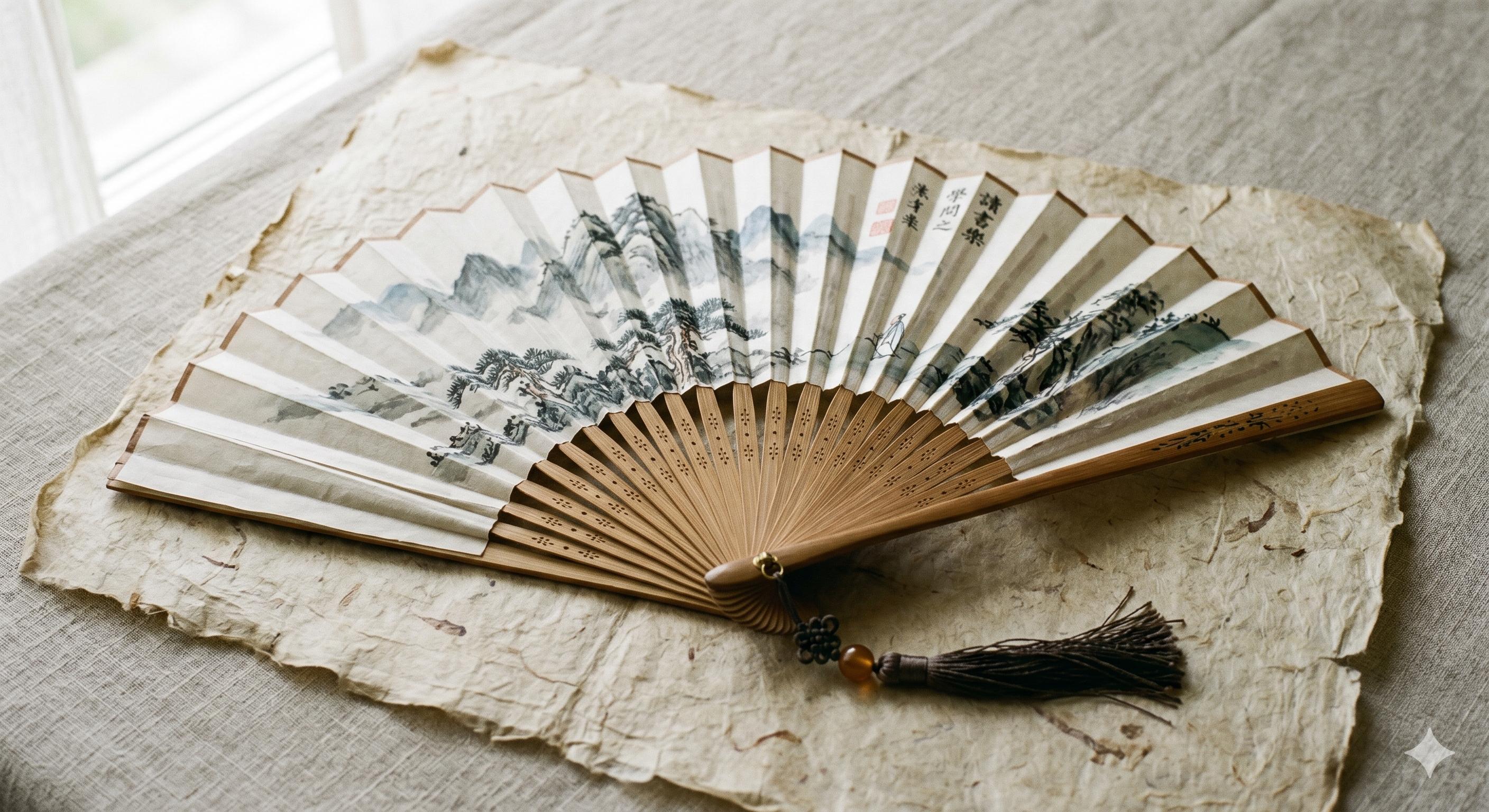
It folds into the size of a pen. Fully opened, it becomes a canvas for ink paintings and poetry. The hapjukseon (합죽선) — Korea's traditional bamboo folding fan — is one of the country's most quietly remarkable crafts, and after centuries of quiet existence, it is finding a new audience.
The fan's name literally translates to "fan made of joined bamboo strips." Each piece is constructed by splitting and layering two outer bamboo strips around a core of hanji — traditional Korean paper made from mulberry bark, renowned for its durability. The process requires more than 140 to 150 manual steps using natural materials. A single misaligned rib means the fan won't fold correctly. The margin for error is close to zero.
How it's made — 4 key stages
Bamboo split into thin strips; outer layers trimmed to precise thickness
Multiple layers of hanji laminated to form the fan surface
Central pivot assembled so the fan opens and closes evenly
Calligraphy, paintings, or patterns applied to the finished surface
The craft has been practiced for approximately 350 years, with Jeonju in North Jeolla Province serving as its historical center. During the Joseon Dynasty (1392–1910), the hapjukseon was far more than a cooling tool. It was carried by scholars and aristocrats as a mark of refinement, decorated with calligraphy and landscape paintings, and presented as a royal gift. Each Dano festival season, it was customary for the king to distribute fans to officials — a tradition known as dano jinseon (단오진선). Pansori singers still hold a fan during performance; tightrope walkers use one for balance.
"It is not just a seasonal item. It can be handed down from generation to generation." — Kim Dong-sik, fourth-generation hapjukseon maker
The survival of this tradition owes much to individual artisans and South Korea's intangible heritage system. The Korean government officially designates intangible cultural heritage under the Cultural Property Protection Act of 1962, classifying masters of traditional crafts as state, city, or province-level heritage holders. Kim Dong-sik, a fourth-generation hapjukseon maker born in Jeonju in 1943, was designated Intangible Cultural Property No. 10 for North Jeolla Province in 2007, and subsequently recognized as a state-designated master of seonjajang — the craft of traditional fan making. His family's lineage in the craft stretches back roughly 140 years. His maternal grandfather, Rah Hak-cheon, created fans for the royal court in the late Joseon era.
Today, the hapjukseon is reaching visitors in a different way. In heritage districts such as Jeonju Hanok Village and Seoul's Bukchon, hands-on fan-making workshops have become a fixture of cultural tourism programs. Visitors — many of them international — can observe the craft process firsthand and produce their own fans. The object has also entered the design market: contemporary versions feature modern color palettes and graphic patterns, and are sold as souvenirs and lifestyle goods. On platforms like TikTok and Instagram, content pairing traditional fans with hanbok (한복) dress has contributed to the object's visibility as a K-culture item.
A well-made hapjukseon using quality hanji is widely believed to last up to 1,000 years. Whether carried as an accessory or purchased as a keepsake, the hapjukseon now functions less as a seasonal utility object and more as a tangible encounter with Korean craft history — one that takes about 150 steps to make, and roughly thirty seconds to fall for.