
Hanji (한지): Why Korean Paper Lasts 1,000 Years
In This Article
This Is Not Just Paper
Most paper falls apart within decades. Hanji, the traditional handmade paper of Korea, has survived for over a thousand years. Documents written on Hanji during the Goryeo Dynasty still exist today in readable condition. That is not an accident. Hanji is made using a process and a material that produces something fundamentally different from modern machine-made paper. Understanding what Hanji is and why it lasts changes the way you look at it entirely.
What Hanji Is Made From
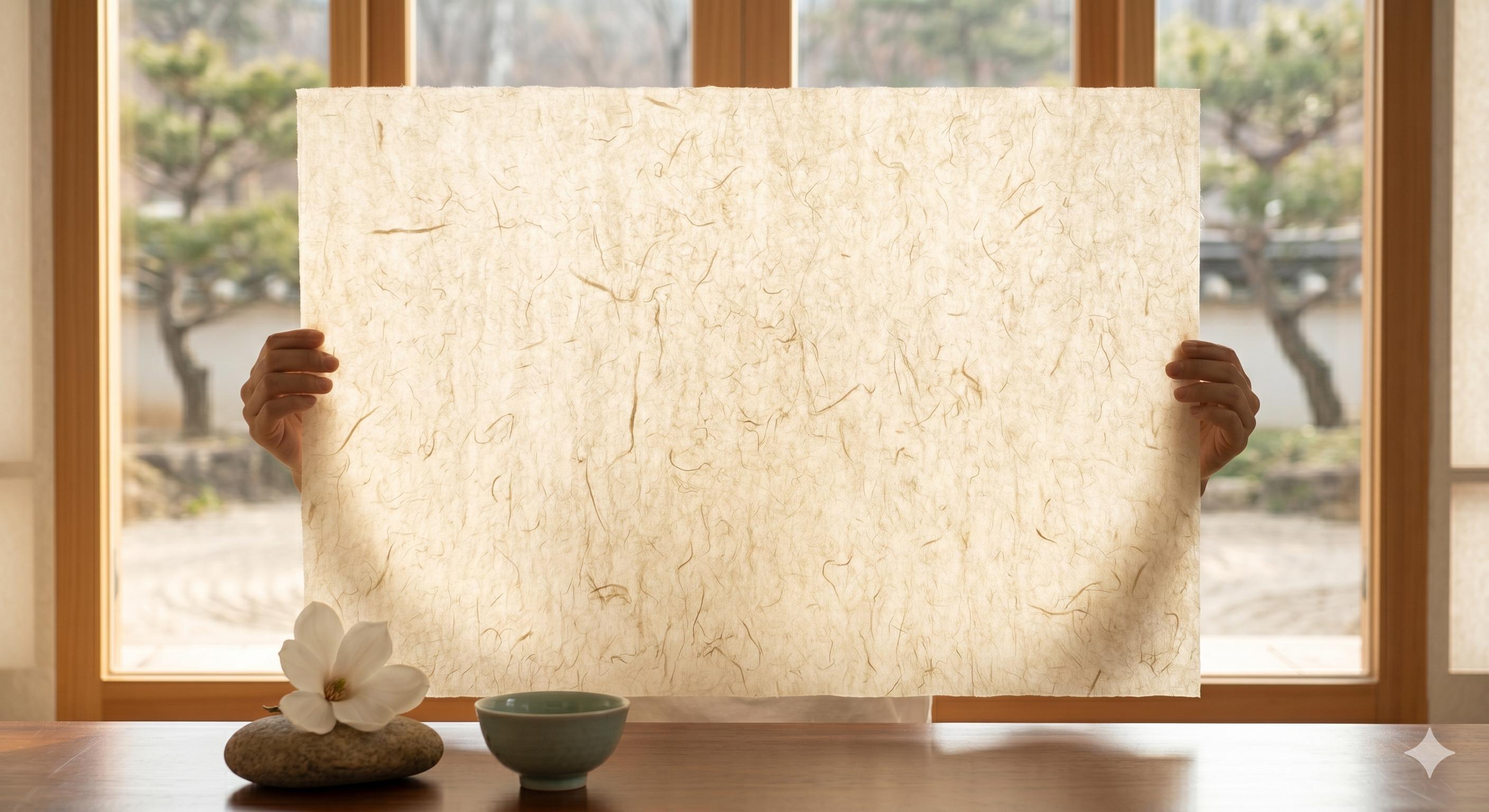
Hanji is made from the inner bark of the paper mulberry tree, called DAKNAMUIF in Korean. The tree grows widely across Korea and has been used for papermaking for at least 1,500 years. The bark fibers are long, strong, and flexible. When processed correctly and formed into sheets, they create a paper that is simultaneously thin and durable. The fibers interlock in multiple directions during the sheet-forming process, which gives Hanji its distinctive resistance to tearing. A single sheet can be folded hundreds of times without breaking at the fold.
How Hanji Is Made by Hand
The production of Hanji involves a process called HEULLIMTTEUKGI, which means flowing and lifting. A craftsperson uses a wooden frame with a fine screen to scoop up a mixture of water and prepared fiber. The frame is then moved in multiple directions simultaneously, causing the fibers to flow and interlock across the surface of the screen. This multi-directional movement is the key step that distinguishes Hanji from Chinese or Japanese paper, where the frame is moved in a single direction. The result is a sheet with a more complex internal fiber structure and significantly greater strength.
After the sheet is formed, it is pressed to remove water and then dried, traditionally on a heated stone surface or in sunlight. No bleaching agents or optical whiteners are used in traditional Hanji production. The natural color of the finished sheet ranges from cream to pale gold depending on the source material and the drying method.
Why Hanji Lasts So Long
The longevity of Hanji comes from several factors working together. The long fibers of the paper mulberry tree are naturally resistant to decay. The traditional production process uses an alkaline water source, which neutralizes the acids that cause most paper to yellow and break down over time. Hanji also has a natural resistance to insects due to compounds present in the mulberry bark. Museums and archives in Korea and internationally now use Hanji for restoration work on damaged historical documents precisely because of these properties. It is one of the few materials that conservators trust for long-term archival purposes.
Hanji in Traditional Korean Life
In traditional Korea, Hanji was not used only for writing. It was used to cover the frames of windows and doors, replacing glass in a way that allowed soft diffused light to pass through while still blocking wind. It was used to make fans, lanterns, kites, and decorative boxes. It was applied to floors and walls as a durable surface coating. Some traditional Korean garments incorporated Hanji as a lining material for insulation. Hanji was so deeply embedded in daily life that it was considered one of the essential materials of Korean civilization, alongside ceramics and silk.
Jeonju: Where Hanji Still Lives
The city of Jeonju in North Jeolla Province is the center of Korea's surviving Hanji tradition. Jeonju Hanji has a history of over 1,000 years and is still produced there by master craftspeople using traditional methods. The city holds an annual Hanji Festival that draws visitors from across Korea and internationally. Several workshops in Jeonju are open to visitors who want to see the production process firsthand or participate in making their own sheets. Jeonju is already well known internationally as a food and culture destination, and its Hanji tradition adds another dimension to what the city offers.
Why Hanji Matters Now
Hanji is experiencing renewed attention from designers, artists, and architects both in Korea and internationally. Its texture, translucency, and durability make it attractive for applications that modern industrial paper cannot serve. Korean designers have used Hanji in lighting fixtures, furniture, fashion accessories, and packaging. International luxury brands have explored Hanji as a material for premium wrapping and presentation. The same properties that made Hanji essential in traditional Korean life are now making it relevant in contemporary design. A material that lasted a thousand years is finding new reasons to continue.