
Local Market Tour #2 — Sokcho Jungang: Eat, Buy, Stay — A Coastal Market Built for Visitors
In This Article
The Market You Didn't Plan For
Sokcho is three hours from Seoul by bus. Most people come for the beach or the mountain. The market is what they didn't plan for — and usually what they remember most.
Walk in and the smell of frying dakgangjeong takes over. Behind it: steamed sundae, open trays of salted seafood, sacks of dried fish stacked against the walls. This isn't a Seoul market. The scale is smaller, the pace is slower, and the sea is close enough that you can feel it in what's being sold.
Gwangjang Market is where you eat fast and leave. Sokcho Jungang is where you end up staying longer than you meant to.
The market is organized by category: fried chicken alley, sundae alley, salted seafood alley, produce alley. The building runs three floors — live fish in the basement, food and fabric on the first, daily goods on the second. The tourist path flows naturally: eat first, then browse, then buy something to take home.
Must-Eats
① Dakgangjeong[닭강정] — Sweet-spicy fried chicken coated in sauce — each stall has its own style: spicy, soy-glazed, garlic. Lines form at the popular ones. Best eaten hot and crispy, straight from the bag. A long-established signature of this market.
② Haesanmul Twigim[해산물 튀김] — The squid here was caught in the East Sea. The shrimp too. By the time it reaches the fryer, it's been out of the water for hours, not days — and that gap matters. Thin batter, minimal seasoning. The seafood does the work. If you've had seafood fritters from an inland city and thought they were fine, this is what fine was supposed to taste like.
③ Abai Sundae[아바이순대] — Brought to Sokcho by displaced people from Hamgyong Province after the Korean War. Larger than standard sundae, packed with blood, vegetables, and glass noodles inside thick pork casing. This is where the dish still exists closest to its original form. You won't find it like this anywhere else.
④ Ojingeo Sundae[오징어순대] — Glass noodles and vegetables stuffed inside a whole squid body, then steamed. Looks unfamiliar, tastes surprisingly mild. The contrast between the chewy squid exterior and the soft filling is the point. Hard to find outside Sokcho.
⑤ Dried Seafood & Jeotgal[건어물 / 젓갈] — Salted pollack roe, octopus jeotgal, dried squid — East Sea specialties, sold for taking home. Not for eating on the spot. This is the market's souvenir layer: the thing people carry out in bags. Cheaper here than in supermarkets.
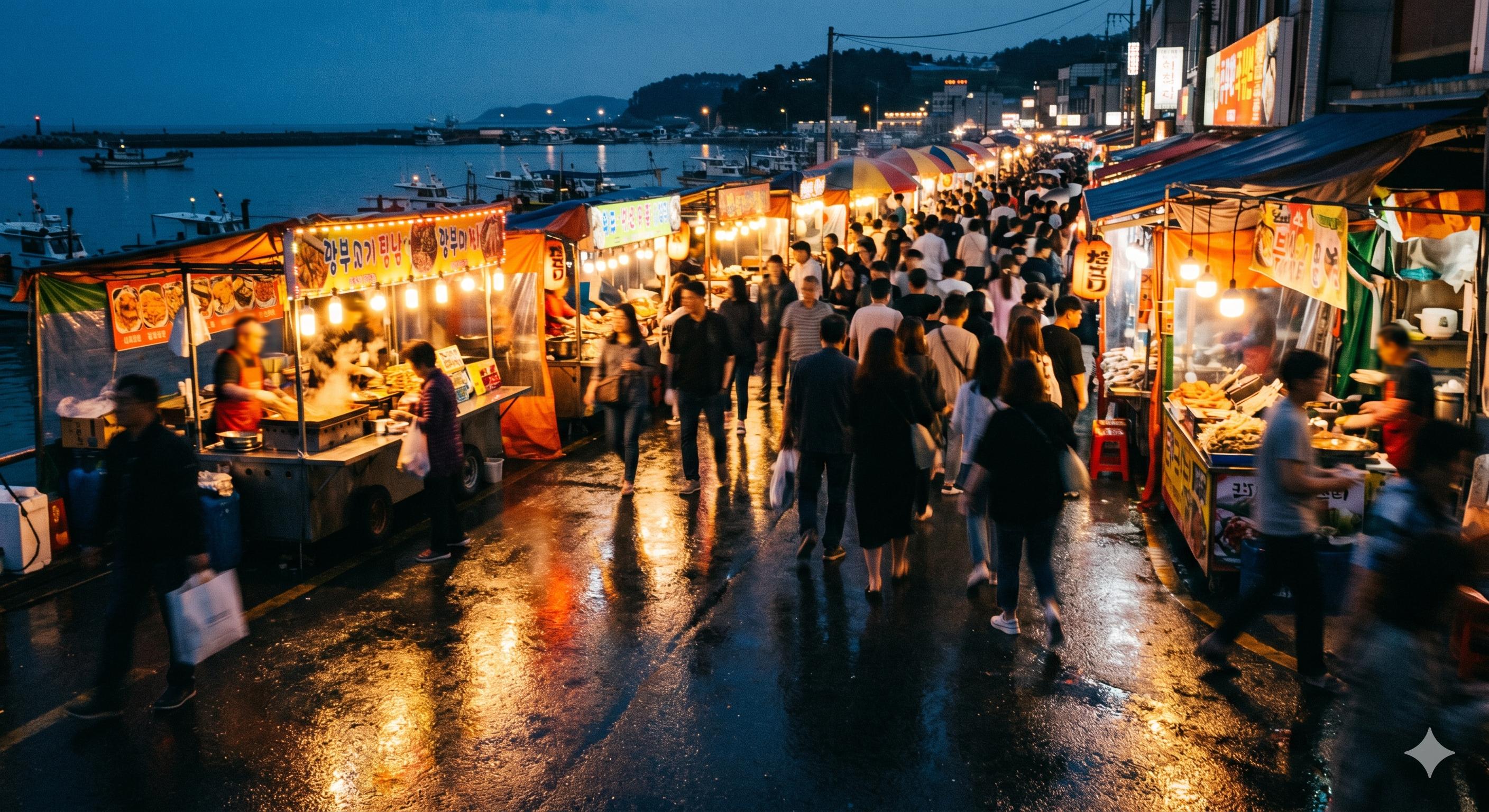
The market shifts with the day. Mornings are local and quiet. Afternoons fill with visitors. By evening, the lights come on and the atmosphere changes — closer to a night market than a traditional one. If you're choosing a time, choose evening.
Gwangjang vs. Sokcho Jungang
| Item | Gwangjang (Seoul) | Sokcho Jungang |
|---|---|---|
| Type | Urban traditional | Tourist-oriented |
| Core Experience | Fast eating | Eat + browse + buy |
| Signature Dish | Bindaetteok | Dakgangjeong |
| Avg. Stay | Under 1 hr | 1–2 hrs |
| Best Time | Morning | Evening |
Before You Go
| Item | Info |
|---|---|
| Hours | Varies by stall / Most open from 10:00 (Produce from 08:00) |
| Night Market | Evening atmosphere from dusk |
| Parking | 350-space lot / 30-min free with 15,000 KRW purchase |
| Access | 10-min walk from Sokcho Intercity Bus Terminal |
| Address | 12, Jungang-ro 147beon-gil, Sokcho-si, Gangwon-do |
| Cash | Cash recommended at most stalls |
Insider Tip
Dakgangjeong varies by stall — the longest line isn't always the best one. Check the stalls deeper in the alley. And if you only have time for one unfamiliar thing, make it abai sundae. It came here with people who had nowhere else to go. That's worth knowing before you eat it.