
Down Perm: Why Korean Men All Get the Same Hairstyle
In This Article
The Science and Culture Behind Seoul's Most Popular Haircut
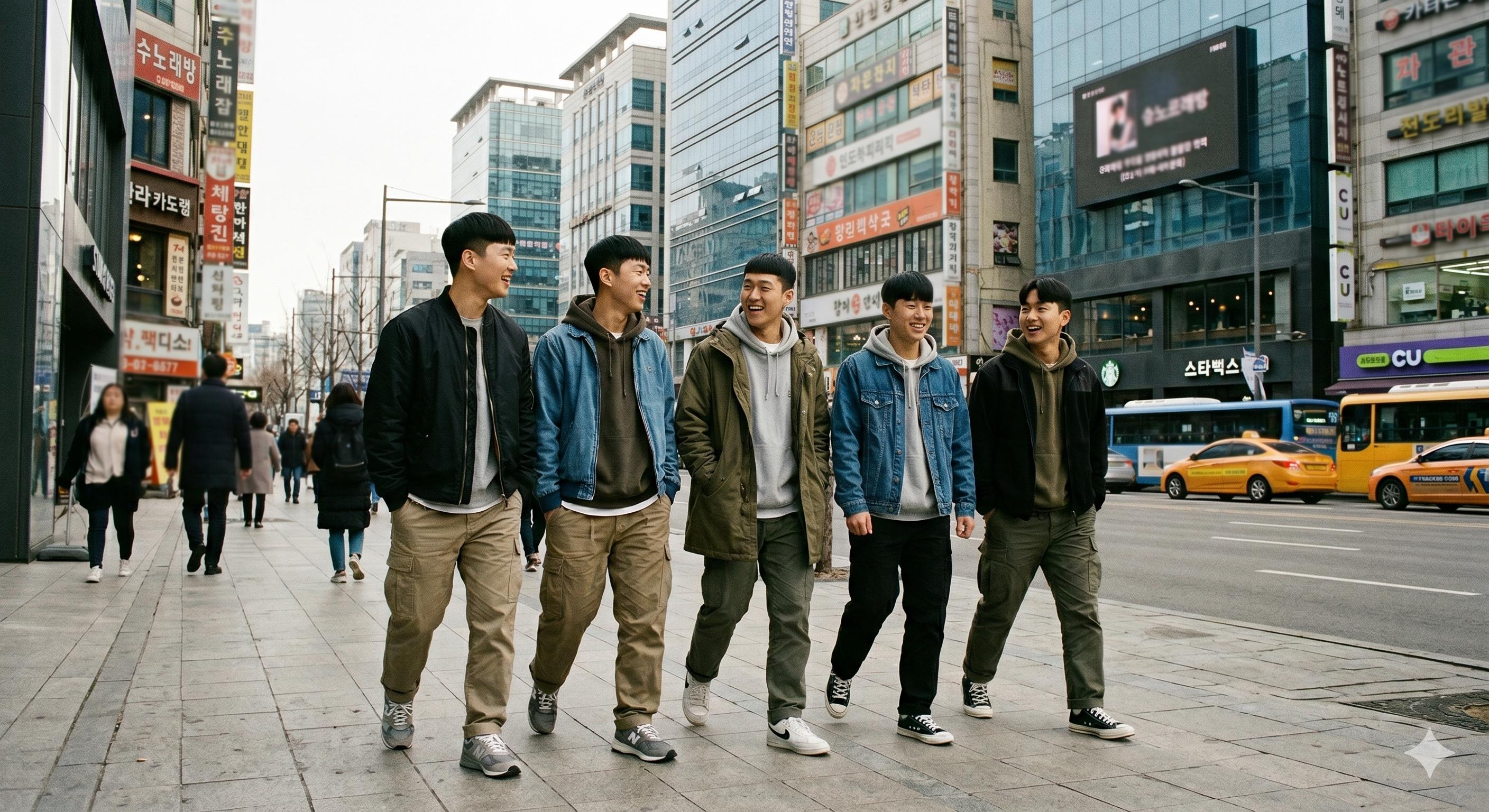
Walk through Hongdae on a Friday night, scroll through Korean drama clips, or glance at any K-pop group's airport footage — and you'll notice something. The hair. Specifically, a particular kind of clean, pressed-down silhouette where nothing sticks out, nothing lifts, and every angle looks intentional.
Koreans call it 다운펌 (down perm). And it's everywhere — a fact that hasn't gone unnoticed by the rest of the world.
What Is a Down Perm?
A down perm is not what most foreigners picture when they hear the word "perm." Rather than adding curl or volume, it does the opposite — using chemical solution and heat to press the hair flat against the head, eliminating the flyaways and lifted sides that naturally occur with short hair. The goal is a clean, slim silhouette: sides that stay down, a back that doesn't stick out, and an overall shape that looks sharp from every angle.
It's a practical fix as much as an aesthetic one. Most Korean men with short hair get one every one to two months just to maintain the line — a frequency that foreign observers find striking. On Reddit, one user noted getting a down perm "once a month," prompting a wave of questions from non-Korean users who had never encountered the concept. The most common reaction: "Wait — you perm your hair to make it flatter?"
Why Is the Down Perm So Particularly Korean?
Part of the answer is biological. East Asian hair is generally characterized by a rounder follicle shape, which produces strands that are straighter and thicker in diameter. Thicker, straighter strands have more structural rigidity — which means they're more prone to sticking outward rather than falling naturally against the head.
Foreign communities discussing Asian hair frequently describe it as "hard to tame," with side hair that lifts and back hair that pokes out regardless of product. This isn't a styling failure — it's a structural characteristic. The down perm isn't a luxury treatment for people chasing a trend. For many Korean men, it's the only reliable way to get the hair to cooperate at all.
This biological reality meets a cultural one. Korean grooming standards place significant emphasis on clean lines and precise silhouette. A hairstyle that lifts or strays at the edges reads as unpolished here in a way that might be considered casual or even natural elsewhere. The down perm is where hair biology and cultural expectation converge: a treatment that solves a structural problem while satisfying an aesthetic standard.
Why Do Korean Men All Get the Same Haircut?
The short answer: screen culture, beauty industry infrastructure, and a deep cultural preference for refinement that presents itself as ease.
Korean beauty culture — for both men and women — operates on the principle of calculated effortlessness. Glass skin takes twelve steps. "No-makeup makeup" involves seven products. The down perm follows the same logic: significant investment made invisible by the result. The goal is never rawness. It's always controlled precision, achieved through consistent upkeep.
That upkeep is backed by serious industry density. Neighborhoods like Gangnam, Sinchon, and Hongdae have hair salon concentrations that are genuinely hard to comprehend until you've walked through them. Trends don't just spread here — they propagate at scale, with salons trained to replicate reference looks with remarkable consistency.
How Did K-Drama Shape Korean Men's Hair Trends?
Korean men's hair trends don't emerge from the streets — they cascade down from screens. When a lead actor sports a particular silhouette across sixteen episodes, salons across the country start fielding the same reference photo within weeks.
The clean, flat-sided look has been the dominant "male lead" aesthetic for long enough that it has graduated from trend to default. It signals a specific archetype: sharp, put-together, effortlessly groomed. For a generation raised on these visual templates, the hairstyle isn't imitation — it's fluency in a shared aesthetic language.
Foreign observers on Reddit have noted the pattern directly: "most guys do it in Korea and it's pretty normal," one user wrote, after explaining the concept to a thread full of people encountering the term for the first time. What reads as uniformity from the outside is, from the inside, simply the baseline.
Why Does Military Service Make This Haircut a Rite of Passage?
Korean men are required to serve in the military, typically in their early-to-mid twenties — and they emerge after 18 to 21 months with uniformly short, unstyled hair. The down perm is, for many, the first hairstyle they actively choose and invest in post-discharge.
It signals a return to civilian identity. To personal style. To the version of themselves that existed before mandatory uniformity. Because so many men go through this transition at roughly the same life stage, the preference reinforces itself across an entire demographic simultaneously — creating a feedback loop between supply, demand, and cultural expectation.
Does Every Korean Man Actually Look the Same?
Not quite — and this is what most foreign observers miss.
Online discussions about Korean men's hair frequently surface the same observation: flat sides, similar bangs, a clean overall shape that seems to repeat across faces and age groups. "Why do Korean men all have the same hairstyle?" is a question that appears regularly in travel forums and K-drama communities alike.
But within the down perm category, there is significant variation that Koreans read as distinct personal expression: how closely the sides are pressed, the length on top, the weight of styling product, whether the overall shape reads rounder or more angular. These distinctions are legible to anyone familiar with the vocabulary.
It's less "everyone looks identical" and more like a shared visual language with its own dialects. Think of how denim works in the West — everyone wears it, nobody thinks everyone looks the same. The down perm is Korean men's denim: a widely shared baseline from which individual expression still operates.
Where Is Korean Men's Hair Trend Heading Next?
The down perm isn't a trend anymore. It's infrastructure — the baseline from which Korean male style currently operates. But Korean beauty culture moves in formation, and when the shift comes, it tends to come all at once.
Early signals suggest a gradual move toward slightly more textured, less uniform styling — influenced in part by the growing visibility of Korean men's fashion on global platforms. Whether that means the down perm's dominance is ending or simply evolving is, for now, an open question.
What's certain is that the next reference photo is already circulating in group chats somewhere. And when it lands in enough salons, you'll know.