
Gochujang (고추장): The Ingredient That Turned Korean Food Red
In This Article
Korean Food Was Not Always Red
The image most people have of Korean food is defined by red. Red kimchi. Red tteokbokki sauce. Red marinades. Red dipping pastes. That color comes almost entirely from one ingredient: GOCHUJANG (고추장). But Korean cuisine existed for thousands of years before GOCHUJANG. Before the chili pepper arrived on the peninsula, Korean food was spiced primarily with black pepper, ginger, and mountain pepper. The red, fermented heat that now feels inseparable from Korean identity is, in historical terms, a relatively recent development — and the story of how it happened is more layered than most food writing suggests.
Where the Chili Came From
The chili pepper originated in Central America and reached East Asia through the global trade networks that expanded after the late fifteenth century. The exact route and timing of its arrival in Korea remain subjects of ongoing scholarly debate. The most widely cited account holds that chili peppers entered Korea around the time of the Japanese invasions of the 1590s, possibly via Japan, where Portuguese traders had introduced them earlier in the sixteenth century.
The earliest surviving Korean written reference appears in the Jibong Yuseol (지봉유설), an encyclopedic text compiled by Yi Su-gwang and published in 1614. The entry describes a pungent foreign plant introduced from Japan, noting it was called waegyoja — Japanese mustard — and warning that it was considered highly toxic. Some researchers at the Korea Food Research Institute have argued that chili-based condiments may predate the Japanese invasions, pointing to references to chojang in fifteenth-century medical texts. The prevailing interpretation in food history, however, is that the chili pepper became established in Korean cuisine during the late seventeenth to early eighteenth century, and that the transition from a novelty ingredient to a culinary staple likely took several generations.
Whatever its exact arrival date, the chili pepper reshaped Korean food more completely than any other single ingredient in the historical record.
How GOCHUJANG Is Made
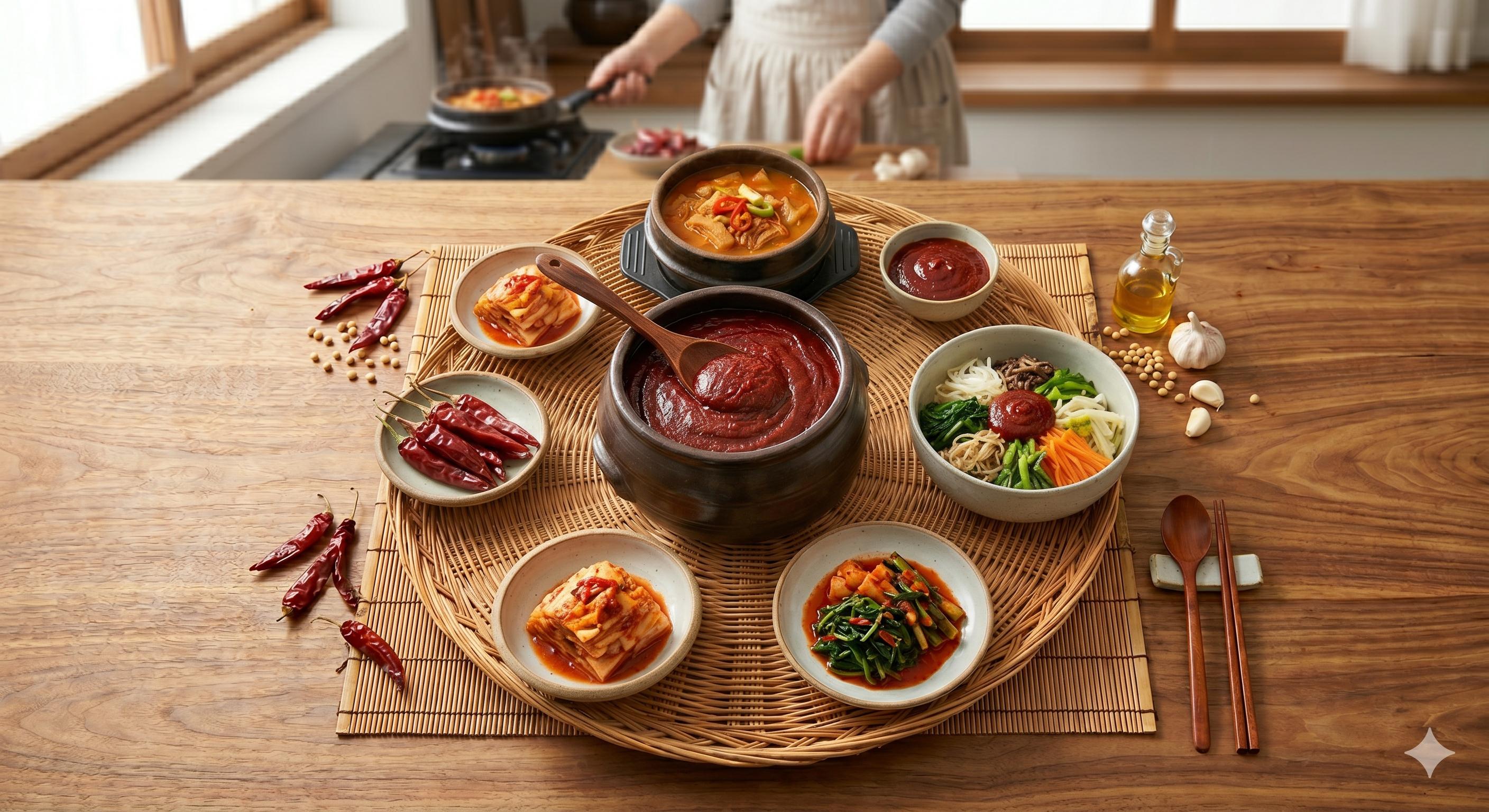
GOCHUJANG is not simply a Korean chili paste. It is a fermented product, and that fermentation is what distinguishes it from other chili condiments. The base ingredients are gochugaru (고춧가루, dried red chili powder), meju powder (from the same fermented soybean blocks used to make DOENJANG and GANJANG), glutinous rice, and salt. Some recipes incorporate barley malt water, which provides enzymes that convert rice starches into sugars during fermentation.
The glutinous rice is cooked and combined with the malt water, then left to saccharify — a process in which the malt enzymes break down starches into sugars, producing a natural sweetness that balances the heat of the chili. The meju powder and gochugaru are then incorporated, and the mixture is salted, packed into ONGGI (옹기) earthenware pots, and left to ferment outdoors. Traditional GOCHUJANG ferments for a minimum of several months and ideally for one to three years. The ONGGI pots allow slow gas exchange through their unglazed walls, supporting fermentation while helping to limit unwanted microbial activity.
The result is a fermented chili paste that is simultaneously spicy, sweet, savory, and faintly sour — a flavor profile that is difficult to achieve without the fermentation process. That complexity comes from the interaction between the chili's capsaicin, the amino acids generated by the meju fermentation, and the sugars produced during saccharification. No single raw ingredient contributes all of this on its own — it is the fermentation that brings it together.
What Makes It Different From Other Chili Pastes
GOCHUJANG is frequently compared to other red chili pastes found across Asian cuisines — Chinese doubanjiang, Thai nam prik pao, or various sambal varieties. The comparison is understandable but somewhat misleading. Most chili pastes build their flavor primarily through the combination of raw ingredients: chili, oil, garlic, shrimp paste. GOCHUJANG builds its depth through fermentation, which generates flavor compounds that are difficult to replicate without the microbial process.
The meju component contributes umami through protease-generated amino acids, in the same way that DOENJANG or aged cheese develops savoriness through protein breakdown. The glutinous rice component contributes fermented sugars that give GOCHUJANG its characteristic sweetness — not sweetness added from sugar or syrup, but a fermented sweetness that tends to feel more integrated and less sharp. The result is a condiment that adds heat, but also depth, color, and a fermented complexity that sets it apart from other chili pastes in practical cooking use.
Sunchang: The Region That Defined It
The earliest surviving written recipe for GOCHUJANG appears in the Somun Saseol (소문사설), a text composed by royal physician Yi Si-pil around 1720. The recipe documented is specifically from Sunchang (순창), a county in what is now North Jeolla Province. The Sunchang recipe of that era already included premium ingredients such as abalone, large shrimp, and mussels — suggesting that GOCHUJANG had already developed a regional identity and a reputation for quality by the early eighteenth century.
Sunchang's association with GOCHUJANG is attributed to a combination of local factors: the quality of the water drawn from the Seomjin River basin, the chili varieties suited to the regional climate, and a tradition of fermentation knowledge passed through generations of producers. The paste made here has a distinct balance of heat and sweetness that producers elsewhere have found difficult to reproduce consistently.
Sunchang GOCHUJANG has been registered under Korea's geographical indication system — a designation that ties the product's name to its regional origin, similar to protections applied to certain European wines and cheeses. Today, Sunchang operates an open-air GOCHUJANG village where producers continue to make paste in traditional ONGGI pots, and the area draws visitors specifically interested in traditional Korean fermentation.
How It Changed Korean Food
Before GOCHUJANG, Korean cuisine used spice in a fundamentally different way. Mountain pepper, black pepper, and ginger were the primary sources of heat and pungency. These were sharper, more volatile spices — their heat dissipated quickly and did not integrate into slow-cooked dishes the way chili-based heat does. Capsaicin, the compound responsible for chili heat, is fat-soluble and relatively stable at cooking temperatures, which means it distributes differently through dishes and lingers longer on the palate.
The introduction of GOCHUJANG did not just add a new ingredient to Korean cooking. It gradually changed the architecture of Korean flavor. Dishes that had previously been built around salty and savory profiles gained a new layer that was simultaneously spicy, sweet, and fermented. Kimchi, which had existed for centuries as a salt-brined vegetable preparation, was transformed. Stews, braises, and dipping sauces were reformulated around the new ingredient.
Over the course of the eighteenth and nineteenth centuries, the fermented chili paste moved from a regional specialty to a household staple present in virtually every Korean kitchen. By the time Korea entered the twentieth century, it had become difficult to imagine Korean food without it.
How Koreans Actually Use It
GOCHUJANG functions across a wider range of applications than many non-Korean cooks expect. In its simplest form, it is eaten as a dipping paste for raw vegetables — cucumber, carrot, radish — where its concentrated flavor needs no cooking to come through. In bibimbap (비빔밥), it is mixed into the bowl at the table, providing heat and acting as the binding element that brings the dish together. In tteokbokki (떡볶이), it forms the sauce base along with a small amount of ganjang and sugar, producing the glossy red coating that makes the dish visually distinctive.
SSAMJANG (쌈장), the paste served with Korean grilled meat for wrapping in lettuce or perilla leaves, combines GOCHUJANG and DOENJANG — using GOCHUJANG for heat and color, and DOENJANG for depth and fermented savoriness. GOCHUJANG is also used as a marinade base for dishes like dak-galbi (닭갈비, spicy stir-fried chicken) and as a finishing element in various stir-fried preparations.
In each case, the fermented character of the paste contributes something that straight chili powder or fresh chili tends not to provide in the same way. It is not just heat. It is heat with depth behind it.
Why It Went Global
GOCHUJANG began appearing in international food media and restaurant kitchens in a meaningful way during the 2010s, driven in part by the global spread of Korean pop culture and in part by a broader interest in fermented and umami-rich condiments. Dishes like bibimbap and tteokbokki reached wide audiences through social media, and GOCHUJANG was identified as the element that gave them both visual and flavor identity.
Non-Korean chefs began incorporating the Korean chili paste into marinades, glazes, and sauces — applications that had little direct connection to traditional Korean cooking but that drew on GOCHUJANG's fermented complexity as a flavor base. This crossover use drew some criticism as a decontextualization of the ingredient, but it also introduced GOCHUJANG to audiences who might not otherwise have encountered it.
The product's growing international presence eventually prompted the Codex Alimentarius Commission — the international body that sets food standards — to register GOCHUJANG under the code CXS 294-2023, establishing agreed-upon quality and composition benchmarks. It is a marker of how far the ingredient has traveled: from a condiment produced in earthenware pots in rural Korea to a product with internationally recognized standards, available in markets across every inhabited continent.
The ingredient that arrived in Korea as an unfamiliar foreign plant, was initially described as toxic, and gradually reshaped the flavor identity of an entire cuisine now reaches supermarket shelves on every inhabited continent. That trajectory — from novelty to transformation to global export — took roughly three centuries. For a fermented chili paste that did not exist in Korea before the seventeenth century, that is a remarkably complete integration.