
Toner Pads: The K-Beauty Shortcut Everyone Is Copying
In This Article
One Pad, Three Steps
Toner pads — pre-soaked cotton pads stored inside sealed containers — have become one of the most frequently discussed K-beauty product categories in international skincare communities. The product itself is not new; in Korea, this format has been mainstream skincare for years. What changed is who began buying them and why.
Overseas, toner pads are often described as a shortcut: a single product that replaces the cotton pad, toner bottle, and separate application step. For users whose morning routines are already longer than they want them to be, reducing steps and friction became the core selling point. The product found its international audience not because of what it adds, but because of what it removes.
What a Toner Pad Actually Is
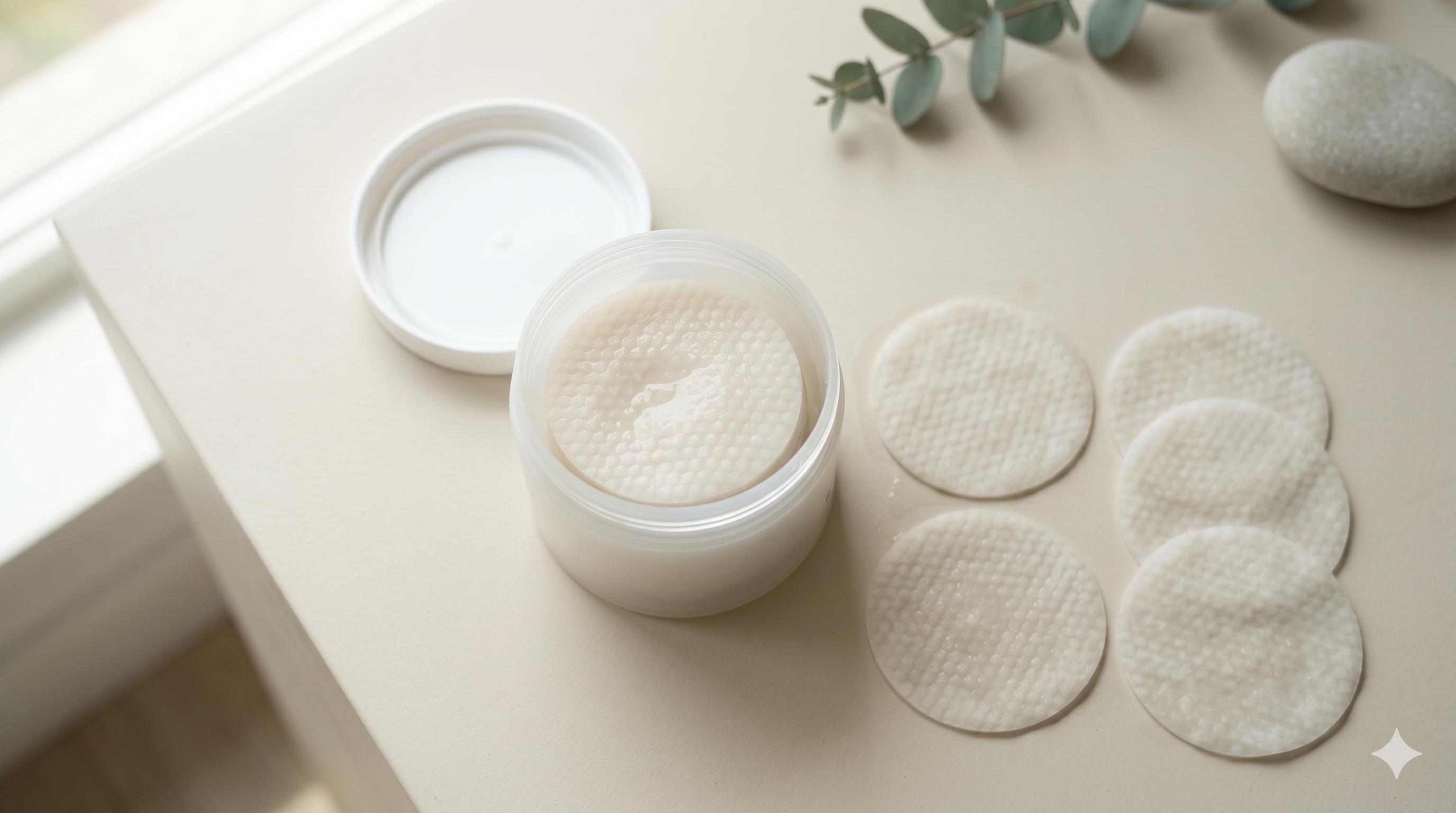
Structurally, a toner pad is a dual-sided cotton pad saturated with a formulated toner solution. The two surfaces often serve different purposes: one side contains embossed texture for gentle exfoliation, while the other remains smooth for hydration and absorption. The pad is wiped across the face after cleansing, delivering toner actives while also performing mild physical exfoliation.
The functional range within the category is broad. Exfoliating toner pads — usually containing AHAs such as glycolic acid or lactic acid, or BHAs like salicylic acid — focus on surface renewal and pore clearing. Hydrating pads prioritize moisture delivery through ingredients such as hyaluronic acid, ceramides, or centella asiatica. Soothing pads target redness and sensitivity. Many formulations combine multiple functions, but the primary effect usually determines how a product is positioned and marketed.
The convenience advantage of the format is straightforward: the pad replaces the separate bottle-and-cotton combination required in traditional toner application, while the pre-soaked format prevents product overuse and eliminates the extra preparation step.
Why “Lazy Skincare” Found Its Perfect Product
“Lazy skincare” is not a Korean skincare concept. The trend emerged as a distinct movement within international — primarily Western — skincare communities driven by users who wanted the results of multi-step routines without the time commitment. The concept explicitly prioritizes lower effort: fewer products, fewer steps, faster routines. It developed partly as a reaction to the highly elaborate 10-step Korean skincare routine that became globally popular during the mid-2010s. Users wanted the outcome without the process.
Toner pads matched this demand unusually well. They collapse a multi-step process — removing cleansing residue, applying toner, allowing absorption — into a single swipe. The format requires no measuring, pouring, or separate applicator. Structurally, it was optimized to reduce friction inside the skincare routine itself.
In international communities, this alignment between product format and user behavior created strong recommendation patterns. Users who openly described themselves as unwilling to maintain full skincare systems consistently identified toner pads as the one step they kept. The product became associated with the minimum viable skincare routine — positioning it well inside communities where complexity itself was the problem being solved.
How Toner Pads Spread Across TikTok
Toner pad content on TikTok follows a highly repeatable structure: the pad is lifted from the container and applied in a single motion while the creator explains how the skin feels or what residue appears on the cotton surface afterward. That second visual element — what the pad visibly removes after cleansing — became one of the strongest engagement hooks in the category. It demonstrates effectiveness visually instead of describing it verbally.
Discovery terms surrounding the trend focused heavily on “morning routine,” “lazy skincare,” and “toner pad” itself. Products from brands such as Some By Mi, COSRX, and Neogen appeared consistently across viral recommendation videos, especially pads positioned around exfoliation, calming, and quick prep before makeup.
Unlike serum or cream content, toner pad videos are visually simple and easy to understand immediately. The format communicates its own function within seconds. That clarity helped the category scale rapidly across short-form platforms where comprehension speed directly affects engagement.
The Three Functional Categories: How Users Actually Choose
Community discussions around toner pads usually organize themselves into three primary use cases. The first is exfoliation: users seeking regular but low-intensity surface renewal use AHA/BHA-based pads to replace separate exfoliating products. This use case appears most frequently among users dealing with texture, congestion, or oily skin.
The second category is hydration. Moisture-focused toner pads are used as the first hydration layer before additional serums or creams, particularly among users with dry or easily irritated skin. In these routines, the pad functions less as exfoliation and more as a quick moisture reset.
The third category is convenience-focused daily maintenance. These users are not necessarily targeting a specific skin concern; instead, they use toner pads as a simplified morning preparation step before sunscreen or makeup. This is where the overlap with “lazy skincare” becomes strongest.
Korea vs. Overseas: Different Products, Different Usage
In Korea, toner pads usually function as one layer inside a broader multi-step skincare structure. They are commonly followed by essence, serum, ampoule, moisturizer, and sunscreen. The pad itself is not positioned as a shortcut; it is simply one optimized step inside a larger process.
Overseas, particularly in markets where elaborate skincare routines never became fully mainstream, toner pads are often treated as a substitute for the entire preparation stage. Users may wipe one pad across the face and move directly to moisturizer or SPF. The product absorbs responsibilities that, in Korea, would normally be distributed across multiple products.
This difference changes how products are evaluated internationally. A toner pad originally formulated as a supporting hydration layer inside a Korean routine may become the primary active skincare step for overseas users. Community discussions increasingly revolve around how these products behave when isolated from the larger Korean skincare structure they were originally designed for.
From Product to Habit
Toner pads achieved something skincare products rarely do internationally: they created skincare habits among users who previously avoided skincare routines entirely. The combination of low effort, immediate tactile feedback, and visible functionality made the category approachable for users who did not identify as skincare-focused consumers.
The significance of the category lies partly in how different its international success model is from earlier K-beauty expansion. The global spread of the 10-step Korean skincare routine emphasized complexity, layering, and aspiration. Toner pads spread internationally by emphasizing reduction, simplicity, and lower maintenance. Both created international demand for Korean skincare — but through almost opposite philosophies.