


Gungsijang: The Ancient Craft Behind Korea’s Legendary Archery
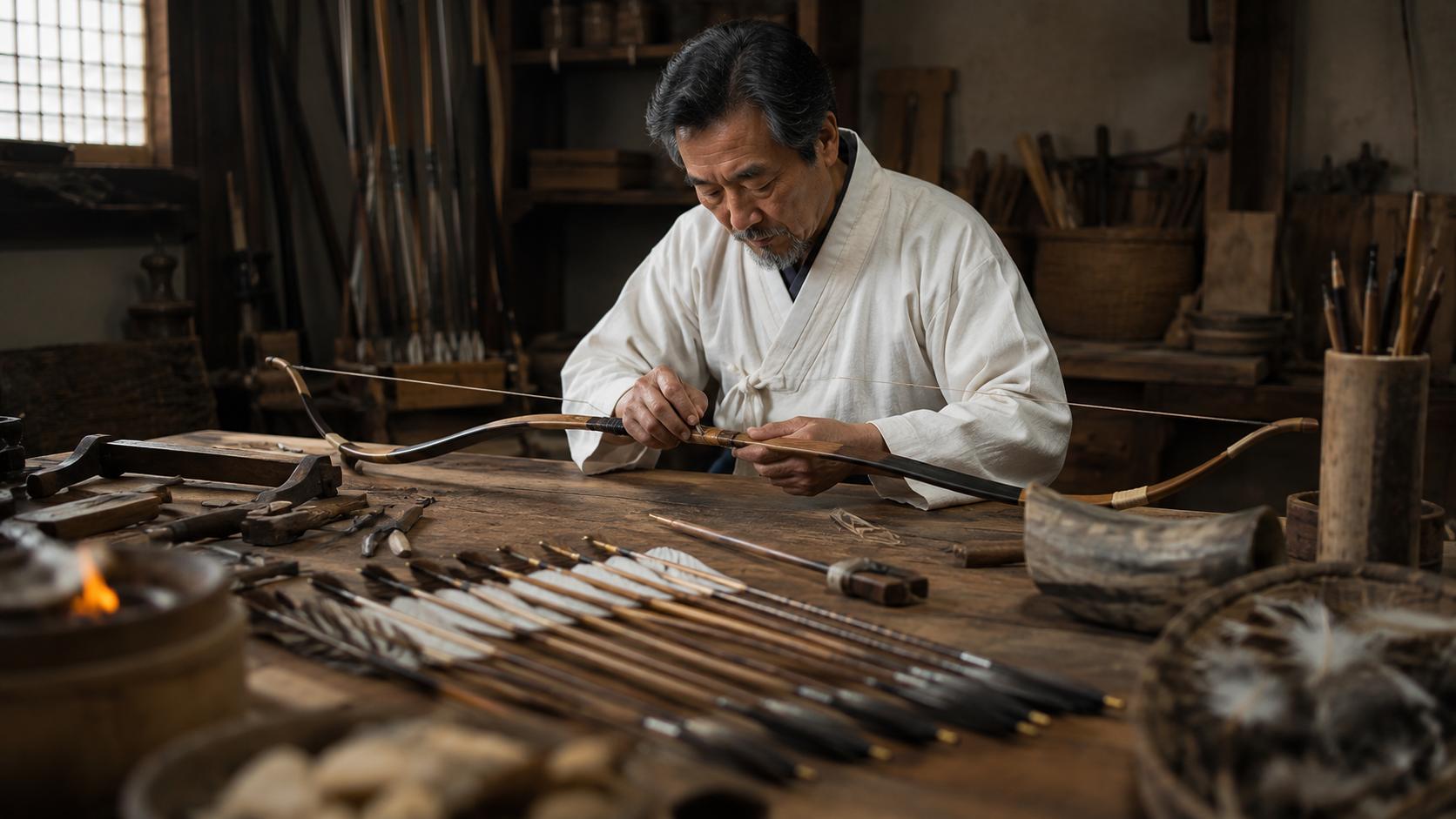
Behind the legendary reputation of Korean archery lies a millennium-old heritage of mathematical precision and natural engineering. Known as Gungsijang, these master artisans are the keepers of Korea's traditional bow and arrow-making lineage. Divided into the Gungjang (bow-makers) and Sijang (arrow-makers), these craftsmen spend months blending materials like water buffalo horn, bamboo, and pheasant feathers into lethal weapons of immense elasticity and grace. This feature explores the meticulous engineering, seasonal patience, and profound cultural legacy preserved by the national living treasures of Gungsijang.
In This Feature
The Dual Masters of Bow and Arrow
In the annals of Korean military history, the bow was considered the supreme weapon, revered for its compact size and devastating range. The creation of these weapons was never a singular task; it required two distinct fields of absolute expertise. Under the single designation of Gungsijang (National Intangible Cultural Heritage No. 47), the craft is split between the Gungjang, who construct the bow, and the Sijang, who manufacture the arrows. Because the materials, tools, and physics required for each component are entirely different, master artisans spend their entire lives specializing in only one side of the craft, ensuring a hyper-focused preservation of ancient technology.
Gungjang: Engineering the Horn Bow
The traditional Korean bow, or Gakgung (horn bow), is a masterpiece of composite engineering. Unlike longbows carved from a single piece of wood, the Gakgung is a reflex bow made by fusing seven organic materials: water buffalo horn, cow sinew, bamboo, mulberry wood, oak, acacia, and a specialized fish glue made from croaker bladders. When unstrung, the bow bends completely backward into a circular shape. The bonding process is incredibly volatile, reacting heavily to moisture and temperature, which restricts the core manufacturing window to the freezing dry months of winter. The result is a highly compact weapon that possesses unparalleled elasticity and projectile velocity.
Sijang: The Physics of the Bamboo Arrow
While the bow provides the raw energy, the arrow dictates the accuracy of the strike. The Sijang focuses on crafting the Juksi (traditional bamboo arrow), a process that requires an flawless eye for symmetry. The shaft is selected from a rare type of slender, dense bamboo known as Siritdae. The core challenge of the Sijang is straightening the naturally curved bamboo stalks. This is achieved through a painstaking process of heating the wood over charcoal embers and manually bending it utilizing a wooden lever until it achieves perfect, microscopic straightness. Balanced with heavy iron tips and stabilized by wild pheasant feathers glued precisely with croaker glue, each arrow is calibrated to withstand the intense force of the Gakgung.
Preserving a Living National Treasure
In the modern era, where carbon fiber and computerized archery dominate global sports, the Gungsijang artisans preserve a vital link to humanity's craftsmanship roots. Each piece of archery gear requires hundreds of repetitive manual adjustments, relying entirely on the muscle memory, tactile intuition, and ancestral blueprints passed down through generations. Today, the workshops of certified Gungsijang masters serve as living archives. By maintaining the raw, natural extraction of ancient materials and showcasing the historical integrity of Korean archery, these artisans ensure that the spiritual and technical excellence of the past remains vibrant and untouched by automation.