


Akgijang: The Craftsmanship Behind Korea’s Janggu
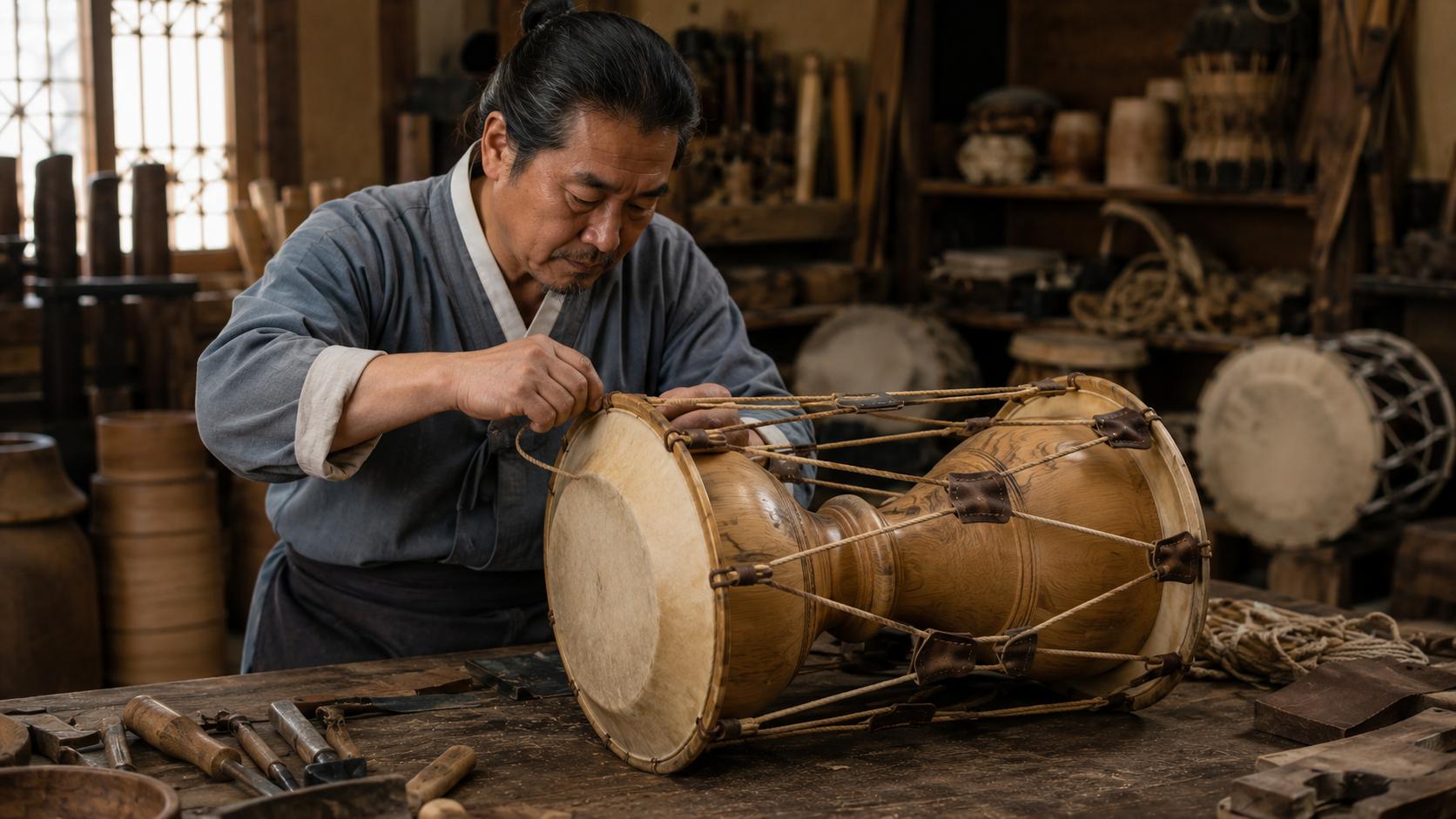
At the heart of Korea's traditional rhythm lies the Janggu—an hourglass-shaped drum that captures the profound philosophical duality of nature. The creation of this iconic instrument is preserved by the master percussion craftsmen known as Akgijang (National Intangible Cultural Heritage No. 42). Rather than merely assembling wood and leather, these artisans act as acoustic engineers and philosophers, carefully calibrating the distinct timber of paulownia wood and selecting contrasting animal hides to embody the cosmic balance of Yin and Yang. This feature explores the meticulous steps, acoustic principles, and spiritual devotion that transform raw natural elements into the living pulse of Korean music.
In This Feature
The Masters of Rhythm and Resonance
In Korean musical tradition, string and wind instruments provide the melody, but percussion establishes the spiritual framework. The masters who craft these essential instruments belong to the highly specialized lineage of Akgijang. While the title spans three distinct disciplines—string, wind, and percussion—the drum-making masters focus entirely on the physics of woodcarving and leather tension. The Janggu, or hourglass drum, is their most intricate masterpiece. It demands that the artisan look beyond mass production, hand-selecting and curing natural materials over years to ensure the instrument reacts perfectly to human touch and changes in climate.
Sculpting the Paulownia Soundboard
The foundation of a magnificent Janggu begins with the selection of the wood. Artisans almost exclusively utilize mature paulownia wood, prized for its lightweight property, porous fiber structure, and exceptional acoustic resonance. The artisan hacks, carves, and hollows out a single log into a fluid, hourglass exterior. However, the true brilliance of the Akgijang lies inside the drum. The master hollows out the left and right chambers to slightly different depths and wall thicknesses. This internal asymmetry is calculated purely by experience and intuition, creating two separate resonant chambers within a single body of wood that amplify different frequency ranges.
The Duality of Hides: Crafting Yin and Yang
What elevates the Janggu to a philosophical instrument is its deliberate use of contrasting natural materials to generate two completely distinct sounds. The Akgijang bridges this sonic gap through expert leather curation. The left side, known as the Gungpyeon, uses thick, supple cowhide or horsehide to produce a deep, reverberating bass that represents the earthly energy of Yin. Conversely, the right side, or Chaepyeon, utilizes thin, tight dogskin or sheepskin to produce a sharp, high-pitched strike representing the heavenly energy of Yang. Splicing these hides together with heavy iron hoops and thick cords, the artisan creates a balanced miniature ecosystem where opposing sounds coexist perfectly.
Preserving the Intangible Pulse
In a modern musical landscape dominated by digital synthesizers and factory-molded drums, the percussion workshops of the Akgijang remain sacred spaces of preservation. Each step—from aging the paulownia wood for years in the wind to manually scraping down animal hides to micrometer thickness—defies modern automation. The tension cords (Guksu) and sliding adjusters must be placed precisely by hand to allow musicians to tune the drum on the fly. By maintaining these exhausting historical processes, the masters ensure that the organic, thunderous, and rain-like timbres of traditional Korean folk music retain their raw, ancestral depth for future generations.