


Jeju’s Volcanic Soil: The Secret Behind Korea’s Perfect Vegetables
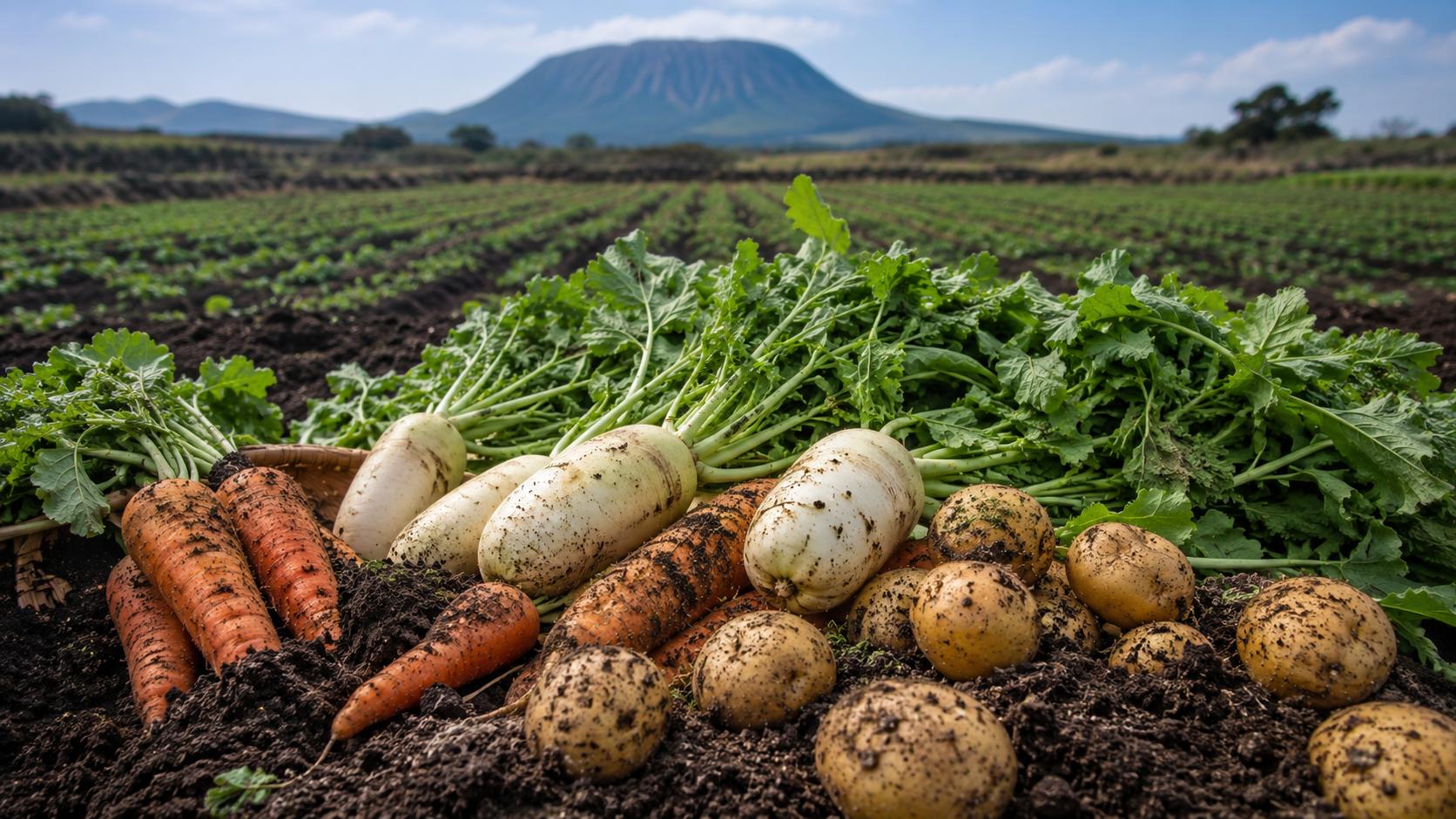
While most volcanic landscapes evoke images of barren desolation and razor-sharp obsidian, the agricultural reality of Jeju Island tells a remarkably gentle story. Beneath the island's windswept surface lies a pitch-black, sponge-like earth known as Volcanic Ash Soil (Andisols). Highly porous, exceptionally rich in organic matter, and structurally pillowy, this unique terrain serves as the ultimate stress-free sanctuary for root vegetables. Free from the compacted resistance of mainland clay, Jeju’s carrots, radishes, and potatoes push through the earth without friction, developing flawless symmetry and concentrated sweetness. This feature explores the silent, underground relationship between Jeju’s volatile volcanic past and the sublime, unblemished bounty of its sub-surface harvest.
In This Feature
Zero Resistance: The Physics of Flawless Growth
The secret to the aesthetic perfection of Jeju's root vegetables lies in the physical texture of Andisols. When stepped on, the ground yields with a distinct, springy resilience—resembling a dense mattress or a natural sponge. For a root vegetable like a carrot or a white radish, the primary obstacle to growth is soil compaction; hard clay forces roots to twist, split, or stunt as they fight for space. In Jeju’s pillowy volcanic ash, however, roots encounter virtually zero mechanical resistance. They expand outward and downward effortlessly, growing perfectly straight, smooth-skinned, and structurally unblemished. It is a stress-free environment that allows the plant to focus all its biological energy on pure development rather than overcoming physical friction.
Hydrological Magic and the Sugar-Stress Mechanism
Because volcanic soil is essentially made of microscopic, porous glass-like particles, it possesses an extraordinary natural drainage system. Water never pools around the roots; it trickles down through the basalt bedrock instantly. This creates a brilliant botanical survival response. To prevent dehydration in the highly draining soil, Jeju's root vegetables voluntarily compress their cell structures and maximize their sugar content. They convert their starch into glucose and fructose, effectively turning themselves into natural antifreeze and sweet reservoirs. This is why a Gujwa carrot or a Daejeon potato tastes remarkably crisp and sweet even when eaten raw right out of the dirt—the sweetness is the plant’s elegant, flavorful answer to the island’s quick-draining soil.
From Volcanic Dust to Culinary Gold
Today, chefs and gourmands across East Asia specifically seek out Jeju-grown root vegetables, treating them less like basic produce and more like artisanal ingredients. The famous winter radishes (Jeju-mu) boast a dense, watery crunch that holds its integrity in long-simmering broths, while the island's red carrots are prized for their vivid beta-carotene color and lack of bitter, earthy aftertastes. By understanding that the flawless shape and intense flavor of these vegetables are direct products of Hallasan’s ancient basaltic breath, we begin to view the humble carrot not just as food, but as a edible piece of volcanic history, beautifully sculpted by the softest earth on earth.