


Why Old Houses in Jeju Used Wooden Sticks Instead of Locks
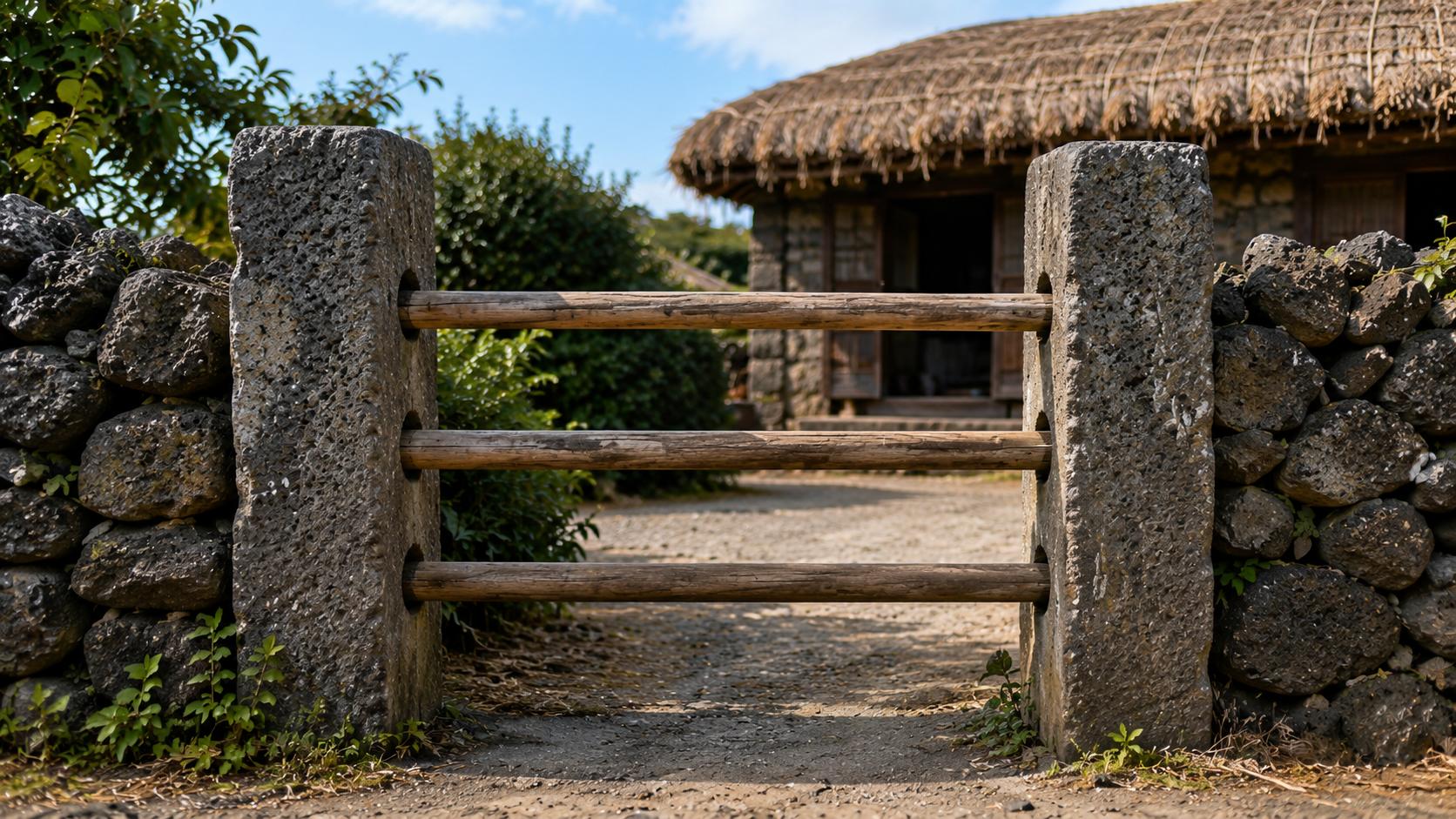
For centuries, traditional homes on South Korea’s Jeju Island operated without front doors, metal keys, or heavy padlocks. Instead, visitors approaching a residence would encounter a deceptively simple structures: two stone pillars with holes slotted with up to three horizontal wooden bars. This is the Jeongnang. While modern travelers often mistake it for a decorative fence or a simple cattle barrier, this minimalist design is actually one of the most sophisticated, lock-free communication systems in architectural history. Built entirely on absolute mutual trust, the Jeongnang allowed homeowners to broadcast their exact whereabouts and availability to the entire village with a single glance.
In This Destination
Decoding the Three-Bar Telegraph
To an outsider, the wooden sticks of a Jeongnang look identical. To a local, however, they read like a real-time status update. The system operated on a precise geometric logic based on how many bars were placed horizontally across the stone pillars:
- One Bar Up: The homeowner is just stepped out nearby—perhaps to a neighbor's house or the local well—and will return shortly. Feel free to wait.
- Two Bars Up: The owner has gone further away, likely tending to the fields or running errands in town, and won't be back until later in the evening.
- Three Bars Up: The occupants are entirely absent, having left the village or traveled to the mainland for days. Passersby should not enter.
- All Bars Down: The gate is wide open. The family is home, welcoming neighbors, travelers, and guests inside.
An Open-Door Architecture Born of Wind and Trust
The brilliance of the Jeongnang lies in its vulnerability. It offered zero physical protection against a determined intruder; any thief could simply lift the logs or step over them. Yet, for generations, crimes were virtually non-existent in Jeju's traditional villages. This phenomenon stems from the island's historical identity, famously defined by the "Samda" (abundance of wind, stones, and women) and "Sammu" (absence of thieves, beggars, and locked gates). Because the harsh volcanic environment required absolute cooperation for survival, the entire village functioned as an extended family. A violation of the Jeongnang's silent code wasn't just a break-in—it was a betrayal of the collective social contract.
The Social Contrast of Modern Security
In an era dominated by biometric smart locks, surveillance cameras, and high-security apartment complexes, the Jeongnang feels almost radically utopian. It reframes the very concept of a gate. Where modern doors are designed to exclude, isolate, and hide what is inside, the Jeongnang was designed to connect, inform, and welcome. It assumed the best in humanity rather than the worst. The physical materials—weathered volcanic basalt stones (Jeongjuseok) and sturdy cedar logs—were sourced directly from the island's landscape, blending seamlessly into the natural environment while fostering an unmatched sense of psychological security.
Preserving the Philosophy of the Open Gate
As modern developments transform Jeju into a bustling international hub, the sight of a functional Jeongnang has largely shifted from everyday neighborhoods to preserved cultural folk villages and minimalist eco-stays. Yet, the philosophy behind it continues to captivate contemporary architects and international travelers alike. It stands as a powerful reminder that the most effective communication doesn't require high technology, and the strongest communities are built not on the strength of their walls, but on the depth of their shared trust.