


Why Jeju Is Known as Korea’s Island of Wind
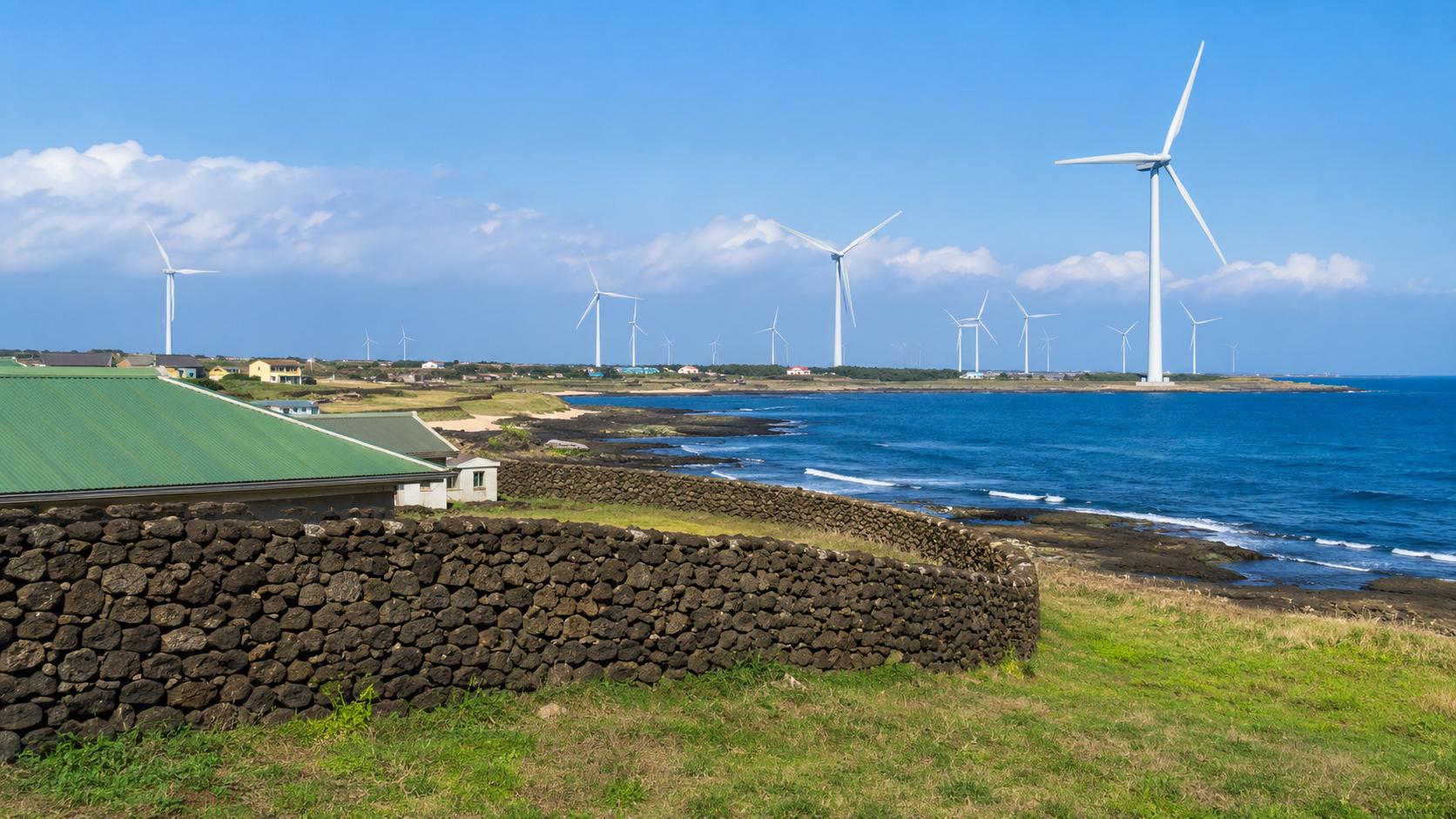
Jeju Island is often introduced as Korea’s tropical getaway — famous for volcanic landscapes, tangerine farms, and dramatic coastlines. But among Koreans, Jeju has long carried another identity: Samdado, or “the island of three abundances” — stone, women, and wind. Of these three, wind has arguably shaped Jeju more deeply than anything else. From centuries-old stone walls built to survive constant gusts to modern offshore wind farms generating renewable energy, life on Jeju has always been defined by adaptation to powerful natural forces.
In This Feature
Why Jeju Became Korea’s Island of Wind
Jeju sits isolated in the Korea Strait, directly exposed to seasonal ocean currents and strong winds moving in from the Pacific. Unlike mainland Korea, where mountains often shield inland regions, Jeju’s relatively open volcanic terrain leaves much of the island vulnerable to year-round gusts. For generations, this environmental reality shaped how local communities lived, farmed, and built their settlements.
This is partly why Jeju became associated with the traditional concept of Samdado, meaning “the island of three abundances.” Historically, Koreans described Jeju as a place abundant in stones formed by volcanic eruptions, women who often led households while men fished dangerous waters, and above all, relentless wind. Unlike many cultural nicknames, this one reflects a literal environmental condition that continues to define the island even today.
How Wind Shaped Jeju’s Architecture and Culture
Perhaps nowhere is Jeju’s relationship with wind more visible than in its traditional architecture. Across the island, visitors will notice low volcanic stone walls called batdam, built not to completely block the wind but to partially let air pass through. Their porous design prevents stronger pressure buildup that would otherwise collapse solid walls during storms. These structures remain one of Jeju’s most recognizable cultural landscapes.
Traditional Jeju homes evolved with the same principle. Houses were often built low to the ground, with carefully positioned courtyards and narrow entrances designed to minimize exposure to harsh coastal gusts. Even everyday routines adapted around the climate. Farmers selected crops capable of surviving frequent wind exposure, while local communities developed a practical mindset centered around resilience and environmental adaptation rather than resistance.
From Ancient Survival to Modern Wind Energy
In recent decades, the same natural force that once made life difficult has become one of Jeju’s most valuable resources. The island now hosts some of South Korea’s most visible wind energy infrastructure, including large-scale coastal and offshore wind farms that contribute to the country’s renewable energy transition. Jeju has increasingly positioned itself as a testing ground for sustainable energy development and carbon-neutral infrastructure.
This creates an unusual continuity between past and present. For centuries, Jeju residents learned how to survive by respecting the island’s powerful winds. Today, modern engineering is doing something remarkably similar — not fighting nature, but designing systems around it. To understand Jeju fully is to understand that wind here is not simply weather. It is one of the invisible forces that has shaped the island’s identity across generations.