


Understanding Jokbo (족보): Korea’s Tradition of Family Genealogies
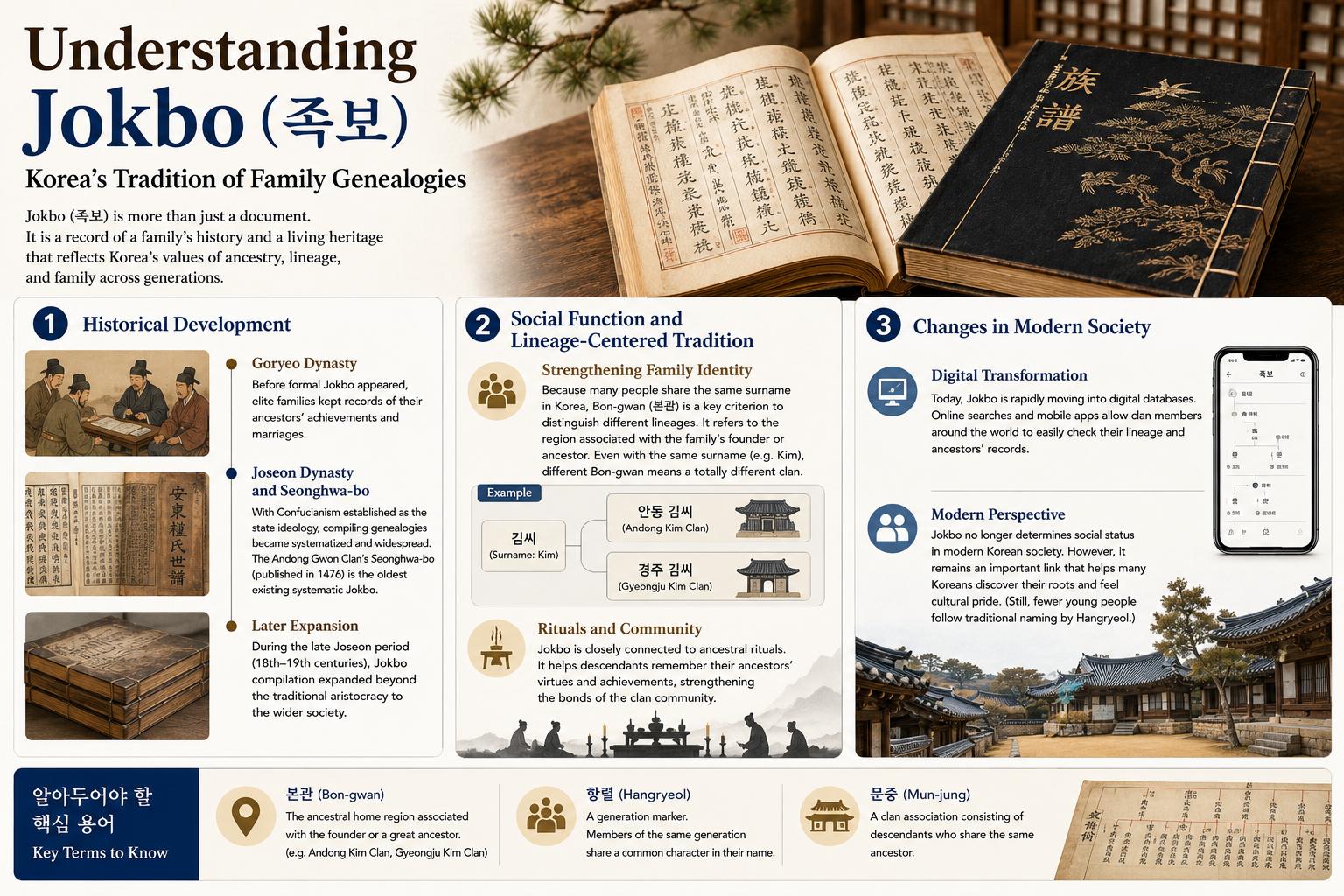
Jokbo, the historical records of Korean family lineages. An essential guide to understanding centuries of family history and the tradition of ancestry in Korean society.
In This Article
Historical Development
In Korea, Jokbo signifies much more than a simple document. It is a record of a family’s history and a unique heritage that encompasses the family values and ancestor worship traditions of Korean society over centuries.
- Goryeo Dynasty Records: Even before the emergence of formal clan Jokbo, elite families maintained genealogical records to preserve their ancestors' achievements and marital ties.
- Joseon Dynasty and Seonghwa-bo: As Neo-Confucianism became the national ideology in the early Joseon period, Jokbo compilation became more systematic. The 'Andong Gwon Clan's Seonghwa-bo' (1476) is the oldest existing systematic Jokbo and became the benchmark for Korean lineage culture.
- Expansion to Late Society: By the late Joseon period (18th–19th centuries), Jokbo compilation expanded from the traditional aristocracy to society as a whole.
Social Function & Lineage Traditions
Jokbo served as a means to solidify family identity. Because many people share the same surname in Korea, 'Bon-gwan' (ancestral seat) functions as a crucial standard for distinguishing different families. Bon-gwan refers to the region associated with a family’s progenitor; even if people share a surname (e.g., Kim), they are historically recognized as belonging to completely different clans if their Bon-gwan differs.
Jokbo is also closely linked to memorial rites (Jerye), which honor and inherit the achievements of ancestors. Through this, family members share a common root and strengthen their solidarity.
Changes in Modern Society
Today's Jokbo is rapidly transitioning from paper booklets to digital databases. Through online searches and mobile apps, family members living across the globe can easily verify their generation (Hangryeol) and ancestral records.
In modern Korean society, Jokbo no longer determines social status. However, it remains an important link for many Koreans to confirm their roots and feel cultural pride. (Note: An increasing number of younger generations do not follow traditional naming methods such as using 'Hangryeol' characters.)
Key Terms to Know
- Bon-gwan: The ancestral root region associated with a progenitor. (e.g., Andong Kim, Gyeongju Kim)
- Hangryeol: A shared character in names indicating members belong to the same generation.
- Mun-jung: A clan association consisting of descendants who share the same ancestors.