


Why Do So Many Koreans Share the Same Surnames?
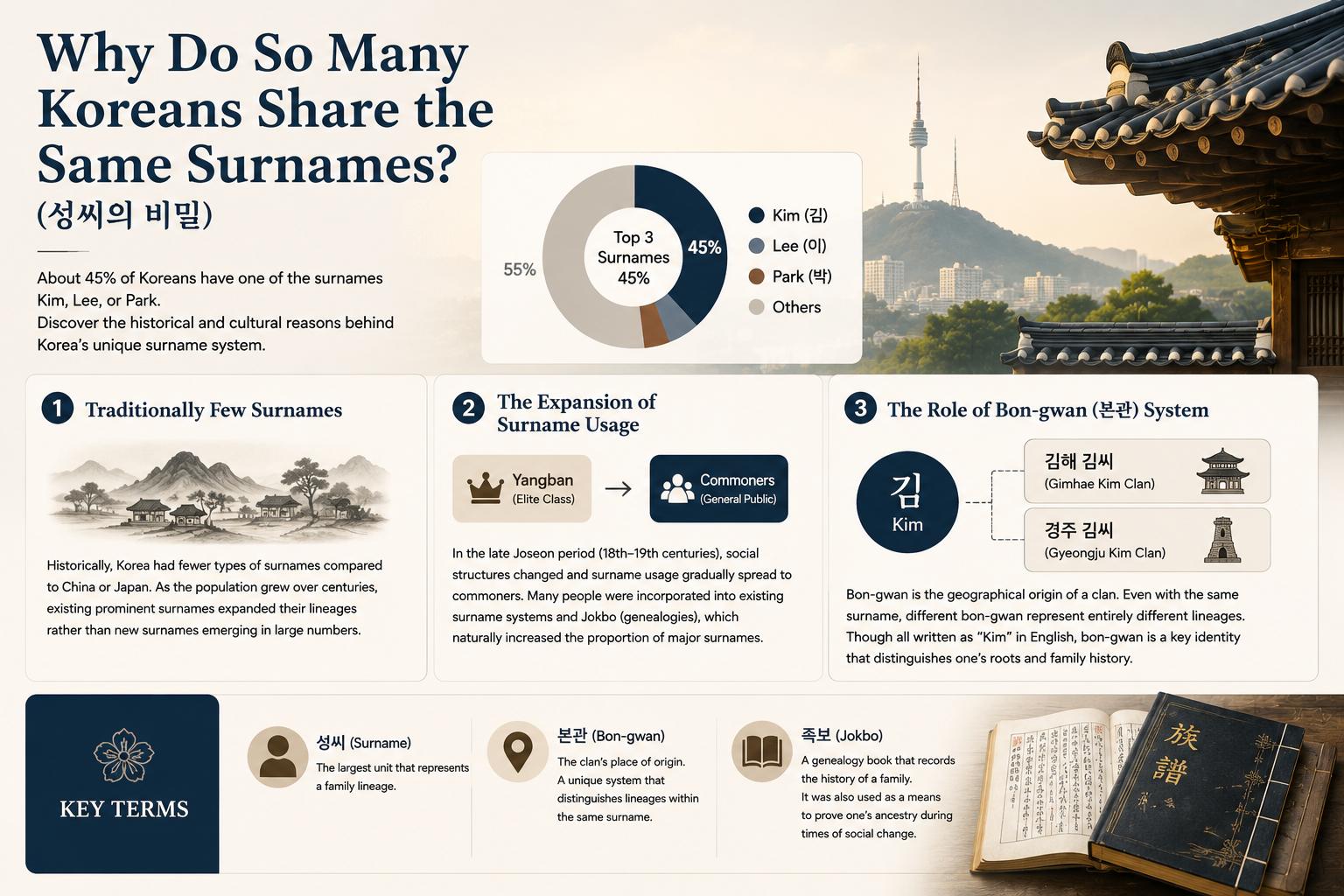
Why do Kim, Lee, and Park dominate the Korean population? Explore the historical background and the unique lineage system behind Korea's surname distribution.
In This Article
Why Are There So Few Surnames?
In Korean society, the three surnames—Kim, Lee, and Park—together account for approximately 45% of the total population. This concentration reflects the unique historical trajectory and cultural background of Korea.
Historically, Korea had a relatively small variety of surnames compared to China or Japan. As the population grew over centuries, rather than creating a vast number of new surnames, society evolved by expanding the lineages of existing, established surnames.
The Expansion of Surname Usage
In the past, having a surname was a symbol of the ruling class. However, as the social structure changed during the late Joseon Dynasty (18th–19th centuries), the use of surnames gradually spread to the commoner class. During this process, individuals and families were incorporated into the existing surname system and the Jokbo (genealogy) system, naturally increasing the proportion of already populous surnames.
The Role of the Bon-gwan System
The limited variety of surnames paradoxically increased the importance of Bon-gwan culture. Bon-gwan refers to the geographical region that serves as the root of a family clan. Even if individuals share the same surname, such as "Kim," if their Bon-gwan differs (e.g., Gimhae Kim vs. Gyeongju Kim), they are historically recognized as entirely different clans. While they are all romanized as "Kim" today, Bon-gwan remains a key criterion for Koreans to distinguish their roots and lineage.
Key Terms:
- Surname: The largest unit representing a family.
- Bon-gwan: The ancestral region of a surname; a unique device to distinguish lineages within the same surname.
- Jokbo: Documents recording a family's history, often used to prove one's roots during periods of social transition.